 Panacea Bio Chem — Formulation Monograph
Peptidic liquid: the peptide formulation behind a stable dose
A peptide is only as good as the liquid it lives in. The peptidic liquid — the peptide together with its cryoprotectants, buffers and scaffolders — is the formulation that decides whether a dose survives freezing, drying, storage and the journey back to solution.

The peptidic-liquid approach, the Dicoias Ψ formulation model and the technology stack that protects it are the work of Bogdan Dicoias — bioscientist, inventor and amino acid chain (AAC) designer, and Director of Panacea Bio Chem.
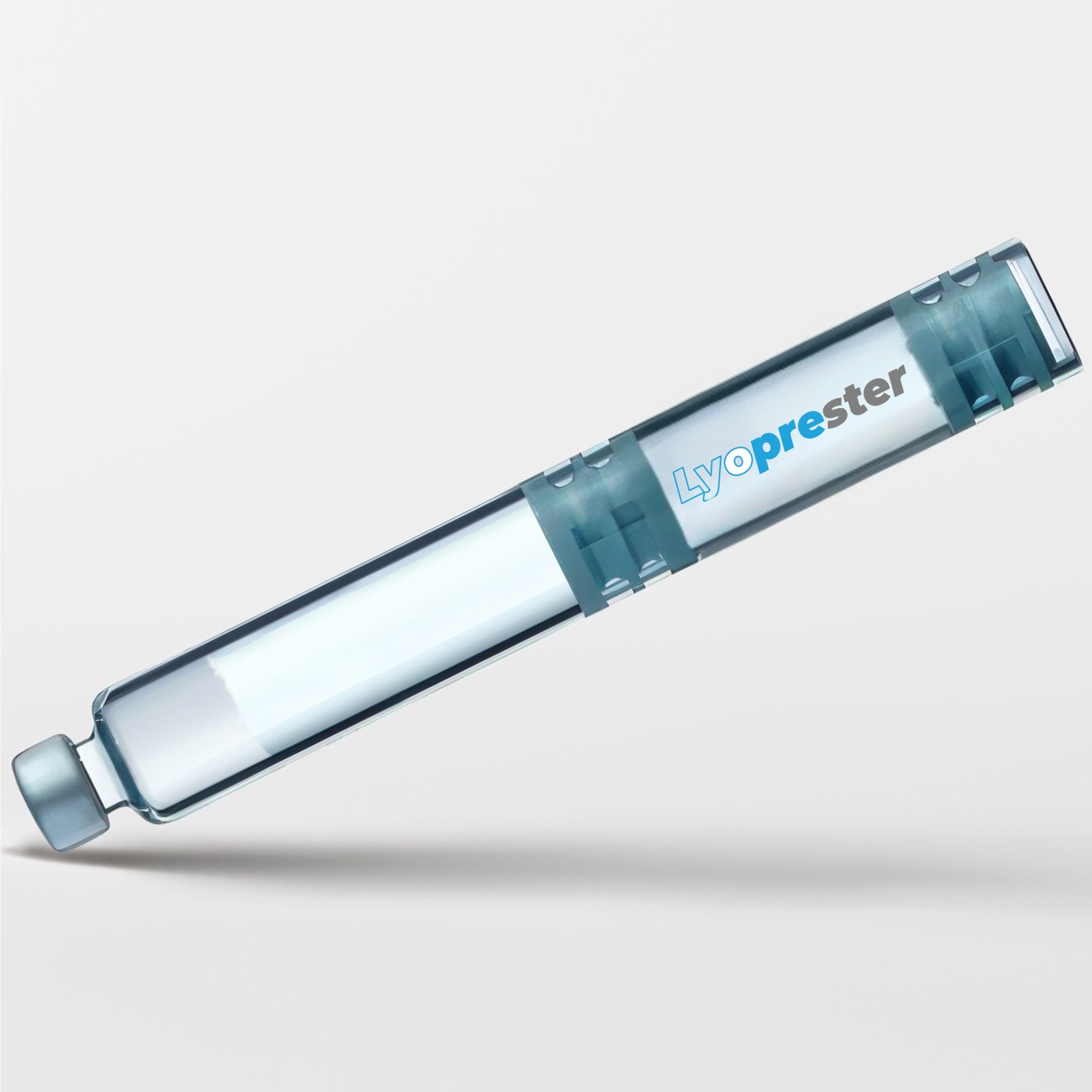
A peptidic liquid is the peptide formulation in solution: the active peptide plus the excipients that protect it — buffers, cryoprotectants, lyoprotectants and scaffolders. It is the liquid destined to be freeze-dried in a Lyoprester® cartridge, or kept protected in liquid form in a Liquiprester™ formulation. Panacea designs it with Dicoias Ψ and defends it across every phase with RF Tunnel™, OxyDeplete™, Argon Lock™, Cryolapse™ and TgShift™.
1. What a peptidic liquid is
A peptide on its own is fragile. Dissolve it in water and it begins to change: chains aggregate, side-chains oxidize, amides deamidate, bonds hydrolyze1. A peptidic liquid is what turns that fragile molecule into a formulation that lasts — the peptide surrounded by a carefully chosen set of companions, each with a job:
- Buffers & tonicity agents — hold pH and osmolality in the window where the peptide is most stable and the dose is physiologically sensible.
- Cryoprotectants — sugars such as trehalose2 and sucrose that shield the peptide as ice forms during freezing, so crystals never crush the molecule.
- Lyoprotectants — the same glass-forming sugars that, on drying, replace the peptide's hydration shell and cradle it in an amorphous glass, so nothing unfolds without its water.
- Scaffolders / bulking agents — the structure-builders that give a freeze-dried cake its shape, mechanical integrity and fast, even reconstitution.
- Chelators & anti-oxidant strategy — sequester trace metals and limit oxygen exposure, the two quiet drivers of peptide degradation.
Get the mixture right and the peptide is preserved; get it wrong and no downstream process can rescue it. The peptidic liquid is the foundation everything else is built on.
2. Why the recipe is the whole game
Shelf life is not a property of a peptide — it is a property of its formulation. The same molecule can last months in one recipe and days in another. Long shelf life comes from matching each excipient to the specific peptide: the right sugar-to-peptide ratio for a robust glass, the right pH to slow deamidation, the right chelation for a metal-sensitive sequence, the right bulking agent for a cake that reconstitutes cleanly.
A peptide is designed once; its peptidic liquid is designed for that peptide — and that formulation is what a long shelf life is made of.
3. Dicoias Ψ — designing the formulation
Panacea does not choose excipients by habit. Dicoias Ψ (DCP Ψ) → is a substance-intelligence model that treats every substance as a vector across physical, electronic, formulation, bio-interface and evidence axes, and scores context-dependent compatibility between a peptide and each candidate excipient — then prescribes the additions that make a formulation coherent. It carries an honesty mechanism that caps its own certainty for unfamiliar substances, so a recipe is never asserted beyond the evidence behind it. Dicoias Ψ is how a peptidic liquid becomes a designed object rather than a guess.
4. Two destinies: dried, or kept liquid
Every peptidic liquid faces a choice of how it will be preserved — and Panacea builds for both paths from the same formulation science.
| Path | Lyoprester® — freeze-dried | Liquiprester™ — kept liquid |
|---|---|---|
| State stored | Dry cake in a glass matrix | Liquid, protected in place |
| Preservation idea | Remove the water the peptide degrades in | Keep the water, but hold the peptide in a protected, chilled, low-mobility state |
| The peptidic liquid is… | The liquid before drying | The liquid as delivered |
| Reconstitution | Tap to redissolve (RF Tunnel™ opens the core) | None needed — already liquid |
Here is the argument worth making plainly: lyophilization is the classic answer — take the water away and the degradation reactions that need water slow to a crawl; the peptide waits, dry and glassy, until a tap of solvent brings it back. That is the Lyoprester® path. But drying is not the only way to protect a peptide. Liquiprester™ keeps the peptidic liquid as a liquid — chilled, cryoviscous, low-mobility, and shielded by the same proprietary technologies — for peptides and workflows where a ready-to-use liquid dose is the goal and the formulation itself can carry the shelf life. Same formulation science, two ways to make it last: dry it beautifully, or hold the liquid beautifully still.
5. The stack that protects the liquid
A peptidic liquid passes through freezing, drying, sealing, storage and reconstitution. Each Panacea technology defends it at one of those moments — together they make a formulation that lasts:
- Cryolapse™ — dries the liquid gently, sublimating ice at low temperature so the peptide's structure is never stressed.
- TgShift™ — raises the formulation's glass-transition temperature so the cake can dry faster without collapse, preserving the glass that cradles the peptide.
- LyoLevit™ — zero-contact, 360° drying that lifts the product and dries it evenly.
- OxyDeplete™ — strips oxygen from the system so oxidation-sensitive peptides are stored oxygen-starved.
- Argon Lock™ — seals the finished cake under argon, not air, for an inert, moisture-guarded shelf life.
- RF Tunnel™ — opens a central channel through the dried cake so the peptidic liquid comes back completely, from the core as well as the surface.
- P-EARL™ — the tuned reconstitution liquid that meets the cake at the tap, chosen for the peptide it must redissolve.
None of these matters without the formulation underneath it, and the formulation reaches its potential only because the stack protects it. That interconnection — a designed peptidic liquid, defended at every phase — is what a Panacea dose is.
Frequently asked
What is a peptidic liquid?
The peptide formulation in solution: the peptide plus
the excipients that protect it — buffers, cryoprotectants and lyoprotectants (such as
trehalose), and scaffolders that give a freeze-dried cake its structure. It is the liquid
later lyophilized in a Lyoprester® cartridge, or kept protected in liquid form in a
Liquiprester™ formulation.
Why does peptide formulation matter for shelf life?
Peptides degrade in water by
aggregation, oxidation, deamidation and hydrolysis. The formulation — which cryoprotectants,
buffers, chelators and scaffolders, and in what ratios — is what slows those pathways. The
recipe is the difference between a dose that lasts and one that does not.
How does Panacea design a peptidic liquid?
With Dicoias Ψ (DCP Ψ), a
substance-intelligence model that scores context-dependent compatibility between a peptide
and every candidate excipient, then protects the formulation across freezing, drying, sealing
and reconstitution with RF Tunnel™, OxyDeplete™, Argon Lock™, Cryolapse™ and TgShift™.
Trending in the field
Recent developments in the field — refreshed 2026-09-09 by Panacea Bio Chem.
- Conformational determinants of glucagon stability and aggregation kinetics in aqueous and commercial formulations — PubMed, 2026 Sep
- From R&D to production: Scale-out of continuous spin-freeze-drying for a PEGylated peptide formulation — PubMed, 2026 Jul 10
- Design of co-lyophilised ternary insulin-sucrose-polymer systems with enhanced amorphous glass stability — PubMed, 2026 Mar 1
- Short Peptides as Excipients in Parenteral Protein Formulations: A Mini Review — PubMed, 2025 Oct 13
References & further reading
- Chemical and physical degradation of peptides and proteins. Wikipedia.
- Trehalose and glass-forming sugars in desiccation tolerance. Nature, Communications Biology (2022).
- Lyoprotectant. Wikipedia.
- Freeze drying (lyophilization). Wikipedia.
- Formulation of peptide and protein therapeutics — literature. PubMed.




